Energy codes on Delmarva and in Ocean City
- sean fahey
- Mar 6
- 5 min read

If you’ve recently received a quote for a roof replacement on your Ocean City condo and felt a bit of "sticker shock," you aren't alone. Between the rising cost of materials and labor, there is a new player in town making things a bit more complicated: the Maryland 2021 International Energy Conservation Code (IECC).
For many property owners and condo associations in Salisbury, MD, and along the coast in Ocean City, these code updates feel like they came out of nowhere. One day we’re talking about R-30, and the next, we’re telling you that your building needs R-49 insulation. It sounds like a lot, because it is. But there is a very specific reason why this is happening, especially for our unique coastal architecture.
At Peninsula Roofing Company, Inc., we’ve been navigating these changes since they were first adopted. Here is the "straight talk" on why these codes changed, who they affect most, and what it means for your next roofing project.
Why the Sudden Change?
Maryland has set some ambitious goals for carbon neutrality, aiming to hit the mark by 2045. To get there, the state adopted the 2021 IECC, which became effective in mid-2023. By May 2024, local jurisdictions, including Ocean City and Salisbury, were required to start enforcing these stricter standards.
Think of your building like a giant thermos. The goal of the 2021 IECC is to make that thermos as efficient as possible. By increasing the "R-value" (the measure of thermal resistance), the state is trying to reduce the amount of energy needed to heat and cool our buildings. While it's great for the environment and eventually your utility bill, it adds a significant layer of complexity (and material) to the roof over your head.
The R-49 Rule: Does it Apply to You?
This is where the confusion usually starts. The code differentiates between "Commercial" and "Residential" based on the height of the building, not necessarily what happens inside it.
If your Ocean City condo is three stories or less, it falls under the residential code. In our region (Climate Zone 4), the standard for these buildings is now a combined R-49 for the ceiling/roof assembly if the insulation is located entirely above the roof deck.
The Concrete Plank and Wood T&G Challenge
In Ocean City, we see a lot of specific construction styles that make this R-49 requirement particularly interesting. Many of our mid-rise and low-rise condos are built with:
Concrete Plank Roof Decks: These are durable and great for coastal weather, but they offer almost zero R-value on their own.
Wood Tongue and Groove (T&G): These beautiful, vaulted ceilings are a staple of coastal design, but they leave no "attic space" to hide insulation.
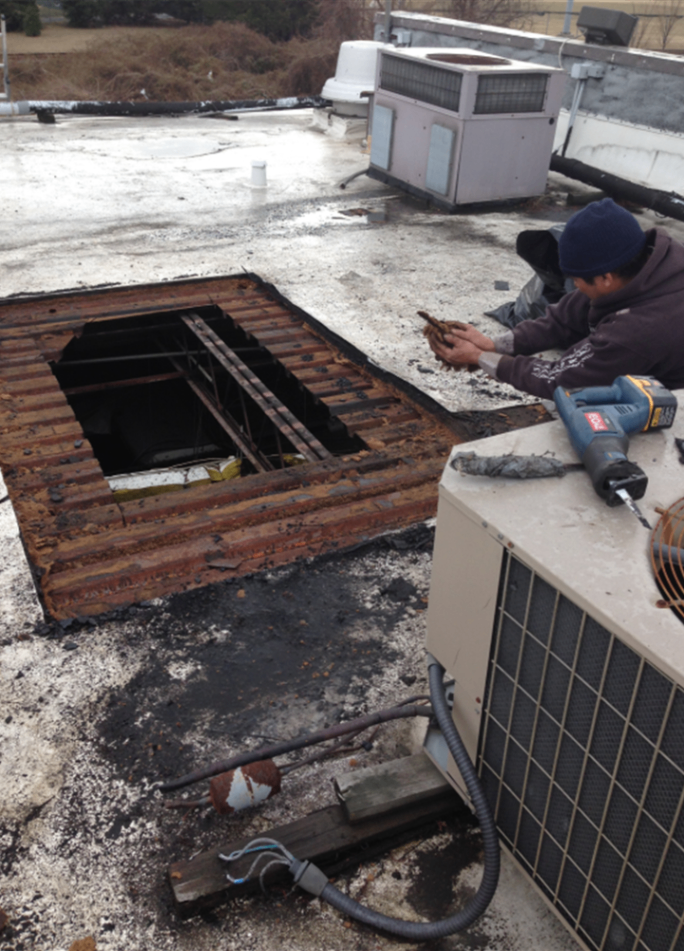
When you have a concrete deck or a T&G ceiling, there is no "void" or crawlspace to blow in fiberglass insulation. That means all of that R-49 thermal protection has to sit right on top of the roof deck, underneath the final roofing membrane. For Ocean City condos with concrete plank or wood tongue and groove decks, reaching that R-49 often means adding significant rigid insulation on top of the deck before the new roof goes down—so the roof system gets thicker, higher, and more detail-heavy at edges, drains, and penetrations. Peninsula Roofing Company, Inc. is the expert in navigating these code requirements in Salisbury, MD and across Delmarva.
Doing the Math: How Thick is R-49?
To give you an idea of the scale, most commercial roofing uses Polyisocyanurate (Polyiso) insulation boards. Polyiso typically has an R-value of about 5.6 to 5.7 per inch.
To hit R-30 (the old standard for many commercial buildings), you needed roughly 5.2 inches of insulation.
To hit R-49, you are looking at nearly 8.5 to 9 inches of solid foam insulation on top of your roof deck.
This isn't just a matter of "more stuff." Adding nearly 9 inches of height to a roof affects everything. It means we have to raise the height of your "curbs" (the platforms your AC units sit on), extend plumbing vents, and rethink the "flashing" where the roof meets the walls or parapets. It turns a standard roof replacement into a significant engineering project.
Why No Insulation in the Ceiling?
You might be wondering, "Why can't I just put the insulation inside?"
As Sean Fahey, our owner, often points out to clients, if there is no ceiling space (like in those T&G vaulted ceilings), there's simply nowhere for it to go. If the insulation is in a ceiling space (an attic), the rules change slightly, and we might not have to add more to the roof deck itself. But for the majority of Ocean City condos where the roof deck is the ceiling, the R-49 has to go on the outside.
Will This Actually Save You Money?
The big question everyone asks is: Is it worth it?
From a monthly power bill perspective, yes. Moving from R-30 to R-49 creates a much tighter thermal envelope. Your HVAC system won't have to work nearly as hard to combat the Maryland humidity in August or the freezing winds off the Atlantic in January. Over time, this saves money on electricity and extends the lifespan of your expensive HVAC equipment because it isn't "short-cycling" or running 24/7.
However, we have to be honest: the upfront cost of the insulation and the labor to raise all the roof-top components is the biggest hurdle. As one of the leading roofing companies in Salisbury, MD, we work hard to source materials efficiently and plan the project to minimize the "re-work" of your rooftop equipment.
How Peninsula Roofing Handles the Upgrade
Navigating these codes requires a contractor who understands the legal requirements as well as the physical ones. When you call Peninsula Roofing Company, Inc., we don't just give you a price per square foot. We perform a comprehensive assessment:
Code Identification: We determine if your building falls under the 3-story residential rule or the commercial standard.
Deck Analysis: We inspect your concrete plank or wood T&G deck to ensure it can handle the weight and the fastening requirements of a 9-inch insulation stack.
Mechanical Coordination: We coordinate the lifting of HVAC units and the extension of vent pipes to accommodate the new roof height.
Tapered Systems: In many cases, we use "tapered insulation" to ensure that, even with all that thickness, water still flows properly to your drains or gutters.
The Importance of Professional Permitting
Don't let a "fly-by-night" roofer tell you that you can skip the insulation to save money. In Salisbury, MD, and Ocean City, the building inspectors are well-versed in the 2021 IECC. If your contractor installs a roof that doesn't meet the R-49 requirement, the project could fail inspection, leading to massive fines and the potential need to tear the brand-new roof back off.
We’ve been serving the Delmarva area since 1947. We’ve seen codes come and go, but the goal has always been the same: providing a roof that protects your investment. Whether you are a property manager for a large condo association or a homeowner in Salisbury, we ensure every project is fully compliant and built to last.
Get an Expert Opinion
The energy code maze is confusing, but you don't have to navigate it alone. If you're concerned about how the R-49 requirement affects your Ocean City condo or your Salisbury business, reach out to us. We can walk you through the math, show you the materials, and help you budget for a roof that keeps you dry and keeps your energy bills in check.
For more information on our specialized services for condos and commercial properties, visit our services page or contact us today for a consultation.
Summary of Key Takeaways for OC Condo Owners:
3 Stories or Less: You are likely subject to the Residential Energy Code.
The Magic Number: R-49 is the new standard for roofs where insulation is above the deck.
The Height Factor: Expect your roof to be significantly "taller" due to the 8-9 inches of insulation required.
Compliance is Key: Always ensure your Salisbury roofing contractor pulls the proper permits and follows the 2021 IECC standards to avoid legal and structural headaches down the road.
Comments