Metal Over Shingles: Why the 'Easy Way' Might Cost You More in Salisbury, MD
- sean fahey
- Mar 19
- 6 min read

It’s a conversation we hear often around the hardware store or over the backyard fence here in Salisbury. A neighbor just got a new metal roof, and they’re bragging about how they saved a few thousand dollars by just installing it right over their old asphalt shingles. They’ll tell you it meets the local building code, it was faster to install, and it looks great from the street.
If you’re looking at your own aging roof and weighing your options, that "overlay" approach sounds like a win-win. But at Peninsula Roofing Company, Inc., we’ve been serving the Delmarva area since 1947, and we’ve seen what happens five, ten, or fifteen years down the road when homeowners take that shortcut.
As Sean often tells our customers, "Just because you can do something doesn't mean you should." While installing metal over shingles might be legally permissible under certain building codes, it is rarely the best choice for the long-term health of your home.
In this guide, we’re going to break down the technical and financial reasons why a complete tear-off is almost always the smarter investment for Salisbury roofing projects.
The "Two-Layer" Code: Legal vs. Logical
First, let’s address the elephant in the room: the building code. In many jurisdictions, including parts of Maryland, the International Residential Code (IRC) generally allows for a maximum of two layers of roofing material. If you currently have one layer of shingles, adding a layer of metal technically "meets code."
However, building codes are designed to be the minimum acceptable standard for safety: not a gold standard for performance or longevity. When you are investing in a metal roof: which can cost between $11,000 and $22,000 for a typical Salisbury home: you shouldn't be aiming for the "minimum." You should be aiming for a roof that protects your family for the next 40 to 50 years.
The Hidden Danger: You Can’t Fix What You Can’t See
The single biggest risk of an overlay is the lack of inspection. Your shingles are just the "skin" of your house. Beneath them is the roof deck (usually plywood or OSB) and the structural rafters.
When we perform a full tear-off, our Salisbury roofing crews strip the house down to the wood. This allows us to inspect for:
Soft Spots and Rot: Water is sneaky. It can leak through shingles and rot the wood decking without ever showing a visible drip on your ceiling.
Inadequate Fastening: If the original decking wasn't nailed down properly or has pulled away over time, we can fix it.
Structural Integrity: We ensure the "bones" of the roof are strong enough to support the new system.
If you install metal over shingles, you are essentially putting a heavy permanent lid on a mystery. If there is a small area of rot starting in your decking, the metal roof will hide it while it spreads. Eventually, the fasteners holding your expensive new metal roof in place will lose their "bite" in the rotting wood. During a high-wind event on the Eastern Shore, that could lead to catastrophic failure.
The Weight Factor: Adding Stress to Your Home
While metal roofing is famously lightweight compared to traditional slate or heavy tile, it isn't weightless. When you leave old asphalt shingles on the roof, you are keeping hundreds (or thousands) of pounds of old material on your house.
A square (100 square feet) of standard architectural shingles can weigh between 230 and 450 pounds. For a 2,000-square-foot roof, that’s roughly 5,000 to 9,000 pounds of old material sitting on your rafters. When you add the metal panels and the furring strips often used for overlays, you are significantly increasing the dead load on your home’s structure. Over time, this can lead to sagging rooflines or even interior wall cracking as the house settles under the extra weight.
The "Sandwich" Effect: Condensation and Moisture Traps
Salisbury, MD, isn't known for its dry desert air. We live in a high-humidity environment, and that humidity plays a massive role in roof performance.
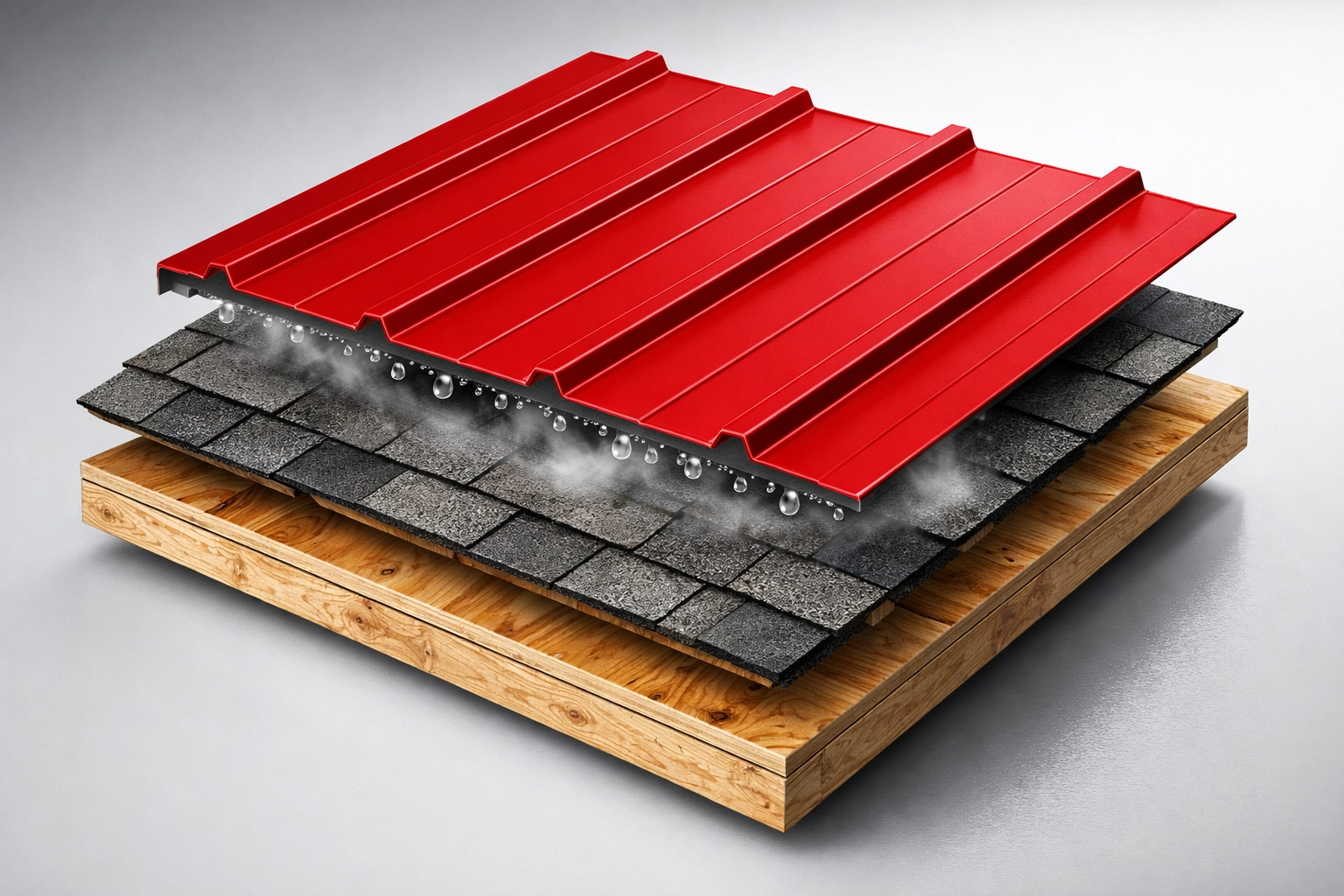
When you install metal directly over shingles, you create a "sandwich" of materials with different thermal properties. Metal heats up and cools down very quickly. Shingles retain heat. When warm, moist air from your attic hits the underside of the cool metal roof, it creates condensation.
If there isn't a clear path for that moisture to escape, it gets trapped between the metal and the old shingles. This moisture has nowhere to go but down into your old shingles and eventually into your wood decking. This "greenhouse effect" can accelerate rot in the roof deck significantly faster than if you had no metal roof at all.
The Abrasive Problem: Shingle Granules and Metal Movement
Asphalt shingles aren’t just “soft” roofing. The surface is covered in mineral granules, and those granules are abrasive (think: sandpaper). That matters because metal panels don’t sit perfectly still over the life of the roof.
Metal expands and contracts as temperatures swing through Salisbury, MD seasons. Over years, that movement can make the underside of the panel (or the underside coating) rub back and forth against the rough shingle granules. Even if the movement is small, it’s constant.
That ongoing friction can wear down the protective coating on the underside of the metal, exposing bare steel in spots. Once that protection is compromised, moisture and condensation can accelerate corrosion, leading to rust spots and, eventually, premature roof failure.
Future Costs: The "Double Tear-Off" Trap
One of the main reasons homeowners choose an overlay is to save on the labor and disposal costs of a tear-off today. However, this is often a "pay me now or pay me significantly more later" scenario.
Eventually, every roof reaches the end of its life. When that day comes for your metal-over-shingle roof, the next homeowner (or you) will be hit with a massive bill. Why? Because the roofing company will have to tear off two separate roof systems.
Increased Labor: It takes twice as long to remove two layers.
Doubled Disposal Fees: Landfills charge by weight. You’ll be paying to dump twice the debris.
Complexity: Removing metal panels that have been screwed through old shingles and into wood is a much more labor-intensive process than a standard tear-off.
By trying to save a few thousand dollars now, you are effectively creating a much larger financial liability for the future.
Performance and Warranties
Most high-end metal roofing manufacturers have very specific installation requirements to honor their long-term warranties. Many of these warranties require a clean, flat surface and specific underlayments.
Installing over uneven, curled, or lumpy shingles makes it difficult to get the metal panels perfectly flat. This can lead to "oil canning" (a wavy appearance in the metal) or, worse, gaps where wind and rain can enter. If the installation isn't perfect because the foundation (the old shingles) was faulty, you might find your warranty claims denied when you need them most.
The Peninsula Way: Doing It Right the First Time
At Peninsula Roofing Company, Inc., we believe in providing value that lasts for generations. That’s why we generally recommend a full tear-off for our residential clients. We want to see your roof deck, ensure your ventilation is up to modern standards, and give you a roof that adds real, appraised value to your home.
When we handle a metal roofing project, we treat it as a precision engineering job. We use high-quality materials and expert craftsmanship to ensure your home can stand up to the storms that roll off the Atlantic and across the Chesapeake.
Summary of the Pros and Cons
Feature | Overlay (Metal over Shingles) | Full Replacement (Tear-Off) |
Upfront Cost | Lower (Save on labor/disposal) | Higher (Initial investment) |
Installation Speed | Faster | Standard |
Deck Inspection | Impossible | Comprehensive |
Structural Stress | High (Heavy load) | Low (New material only) |
Moisture Risk | High (Condensation trap) | Low (Proper ventilation) |
Future Disposal | Very Expensive | Standard |
Warranty Security | Risky | Strong |
Why Choosing the Right Salisbury Roofer Matters
Choosing between roofing companies in Salisbury MD is about more than just finding the lowest bid. It’s about finding a partner who will be honest with you about the risks of shortcuts.
If a contractor is pushing an overlay simply to make their price look more attractive, they might not have your best interests at heart. A truly professional roofer will explain that the "easy way" today is often the most expensive way in the long run.
If you are considering a metal roof for your home, we would love to help you do it the right way. We can walk you through the inspection process, explain our ventilation strategies, and help you choose a metal system that will be the last roof you ever have to buy.
Ready to protect your home for the long haul? Contact us today for a comprehensive inspection and a quote that you can trust. We’ve been protecting Delmarva since 1947, and we’re not about to start taking shortcuts now.
Comments