The Steep Roof Myth: Why Every Detail Still Matters (Especially at Pitch Breaks)
- sean fahey
- Apr 15
- 5 min read

Hey Sean, here is that deep dive into the "steep roof myth" we discussed. It’s a common point of confusion for many homeowners in Salisbury, MD, who think a high pitch is a get-out-of-jail-free card for roofing maintenance. This post breaks down why the details are actually more critical when gravity is working overtime.
There is a common school of thought among homeowners: and even some less-experienced roofing companies in Salisbury, MD: that a steep roof is a "safe" roof. The logic seems sound on the surface: if the roof is nearly vertical, water has no choice but to run off immediately. Gravity is the ultimate ally, right?
While it is true that steep-pitched roofs excel at shedding water and snow compared to their low-slope counterparts, this high-speed runoff creates its own set of challenges. At Peninsula Roofing Company, Inc., we’ve been serving the Delmarva Peninsula since 1947. Over those 75+ years, we’ve seen countless "steep" roofs fail not because of the shingles themselves, but because someone fell for the myth that the details didn't matter as much.
In reality, a steep roof is only as good as its most complex transition. If you are looking for a roofer in Salisbury who understands that "fast water" can be dangerous water, you have to look past the pitch and focus on the details: specifically at the pitch breaks.
The Danger of "Fast Water"
When rain hits a 12/12 pitch (a 45-degree angle), it gains significant velocity as it travels toward the gutters. By the time that water reaches a transition point, a valley, or a pitch break, it isn't just trickling; it’s a localized flood.
If the flashing isn't perfect, or if the underlayment wasn't installed with the proper overlaps, that high-velocity water can actually find its way under the roofing material. This is especially true during the heavy summer thunderstorms we get here in Salisbury, MD, where wind can drive rain sideways and upward.

A steep slope doesn't mean you can relax on the "small stuff." In fact, shingle attachment is more difficult on steep pitches. Asphalt shingles rely on a combination of nails and a thermal seal strip. On a very steep roof, the weight of the shingle is constantly pulling against that seal. If a Salisbury roofer doesn't use the correct "high-nailing" pattern required for steep slopes, or if they install during a window where the seal doesn't properly bond, those shingles can eventually slip or blow off, leaving the deck exposed.
The Critical Role of Pitch Breaks
The most dangerous part of any roof isn't the wide-open expanse of shingles; it’s where the roof changes direction or slope. These are known as pitch breaks.
You see these often on Delmarva homes: perhaps a steep main roof transitions into a shallower porch roof, or a gambrel-style roof changes pitch halfway down the side. To the untrained eye, it looks like a simple line. To a professional roofer in Salisbury, it’s a high-risk zone for leaks.
Why Pitch Breaks Fail
Water Turbulence: When fast-moving water from a steep upper slope hits a shallower lower slope, it slows down abruptly. This creates a "splash-back" effect. If the transition flashing isn't tucked deep enough under the upper shingles, that splashing water can work its way behind the lower roofing system.
Ice Damming: In the winter, snow may melt off the steep upper section (which catches more sun) and refreeze when it hits the flatter, colder lower section. This creates an ice dam right at the transition. As the ice builds up, it forces water backward under the shingles.
Expansion and Contraction: Different slopes move at different rates as they heat and cool. Without the right "detail work" at the break, the roofing materials can stress and crack over time.
Interior Moisture: The Silent Threat
It’s not just the water coming down that we have to worry about; it’s the moisture coming up.
In many homes in Salisbury, MD, pitch breaks often align with interior wall headers or changes in ceiling height. If a roof transition isn't properly ventilated or insulated, it becomes a "cold spot." Warm, moist air from inside your home: from showers, cooking, or even just breathing: rises to the highest point. When that warm air hits a cold transition point at a pitch break, it condenses into liquid water.
Many homeowners see a brown stain on their ceiling near a pitch break and assume the roof is leaking. In reality, it might be an "interior leak" caused by poor detailing of the roof’s thermal envelope. This is why we emphasize that a roof is a system, not just a layer of shingles.
The Peninsula "Repair First" Philosophy
At Peninsula Roofing Company, Inc., we know that a leak at a pitch break doesn't always mean you need a brand-new roof. Many Salisbury roofers will see a complex leak and suggest a full replacement because it’s easier for them to bid. We take a different approach.
We believe in a "repair first" philosophy. Because we have a dedicated team just for the small stuff, we can often go in, strip back the problematic transition, install the correct custom flashing, and save the rest of the roof.
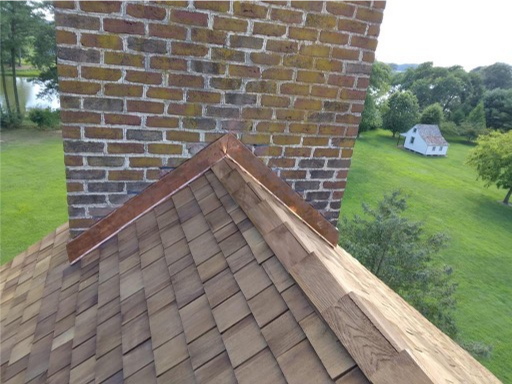
Whether it's a chimney transition or a complex gambrel break, the detail work is what determines the lifespan of the repair. If you fix the detail, you fix the problem. You don't always need to spend $15,000 when a $1,500 expert-level detail fix is what’s actually required.
Why Experience Matters in Salisbury, MD
The Delmarva climate is unique. We deal with high humidity, salt air (if you’re closer to the coast), and drastic temperature swings. A roof that works in the desert won't work here.
When you are comparing roofing companies in Salisbury, MD, ask them about their experience with complex transitions. Anyone can nail shingles to a flat plane. It takes a craftsman to handle a pitch break where water, ice, and interior moisture all collide.
We’ve seen the "quick fixes" from other companies fail after just one season. Usually, it’s because they used standard "off-the-shelf" flashing instead of custom-bending a solution to fit the specific angle of the pitch break. Or, they skipped the ice and water shield membrane because "the roof is so steep, the water will just run off anyway."
What to Look For During an Inspection
If you have a steep roof with multiple angles, keep an eye out for these red flags:
Shingles that look "wavy" at the transition: This suggests the underlayment is bunching or moisture is trapped.
Granule loss concentrated at the break: This indicates high-velocity water is "scrubbing" the shingles at that specific spot.
Rust on flashing: If you can see metal at the pitch break and it’s rusting, the protective coating is gone, and a leak is imminent.
Dark streaks: These can be algae, but if they start exactly at a transition, it’s a sign that water is lingering there longer than it should.
Conclusion: Don't Let the Pitch Fool You
A steep roof is a beautiful architectural feature: it gives a home character and provides great drainage. But don't let that incline lull you into a false sense of security. The details matter just as much on a 12/12 pitch as they do on a flat roof.
If you’re concerned about a transition point, or if you’ve been told you need a full replacement for a leak that seems localized to a pitch break, give us a call. With over seven decades of experience as a premier salisbury roofer, we have the expertise to diagnose the root cause and provide a detail-oriented solution that lasts.
Don't let a small detail turn into a big disaster. Whether you need a minor repair or a comprehensive inspection, Peninsula Roofing Company, Inc. is here to help keep your Salisbury home dry and secure.
Ready to have an expert look at your roof’s details?Contact us today to schedule a professional evaluation.

Comments