When the Wind Takes Off: Understanding Roof Blow-offs and Lift in Salisbury, MD
- sean fahey
- Mar 10
- 6 min read

Living on the Delmarva Peninsula, we are no strangers to the power of the Atlantic. In Salisbury, MD, we see our fair share of Nor’easters, summer thunderstorms, and the occasional tropical system. While most homeowners and commercial property managers worry about a small leak here or a missing shingle there, there is a much more dramatic: and expensive: event that keeps roofing professionals up at night: the catastrophic blow-off.
When a roof fails during a high-wind event, it isn't just "falling apart." It is often being actively lifted off the building by the same physical principles that allow a 200-ton Boeing 747 to take flight. Understanding the "why" behind these failures is the first step in preventing them. At Peninsula Roofing Company, Inc., we’ve been inspecting and repairing these systems since 1947, and we’ve seen exactly what happens when the wind decides to take a roof for a ride.
The Airplane Wing Effect: Your Building in the Sky
To understand a roof blow-off, you have to think like an aeronautical engineer. Imagine your building is an airplane wing. When wind hits the side of your building, it is forced upward. As the air moves over the leading edge of the roof and across the flat surface, it accelerates.
That acceleration matters because it changes pressure. As wind speed increases across the top of the roof, the pressure above the membrane drops compared to the pressure inside the building. This pressure difference is what creates lift—the same basic “airplane wing” concept, just happening to your roof in Salisbury, MD.
In a perfectly sealed building, the roof’s attachment (adhesive, fasteners, perimeter edge metal, and the deck connection) counters that uplift force. But if the building envelope is breached—like a broken window, a blown-open man door, or a loading dock door stuck open—the internal pressure can spike. Now the roof is getting pushed up from below while the wind is pulling up from above. That’s when “blow-off” becomes a real risk.
The "Jack-Straw" Effect: When Adhesion Fails (and When Wind Simply Overpowers a System)
In many commercial roofing systems in Salisbury, MD, we use a "fully adhered" or "mechanically attached" system. When we go out to inspect a roof after a storm and see that the membrane is still mostly in place but looks like a wrinkled sheet or a series of rolling hills, we call this billowing.
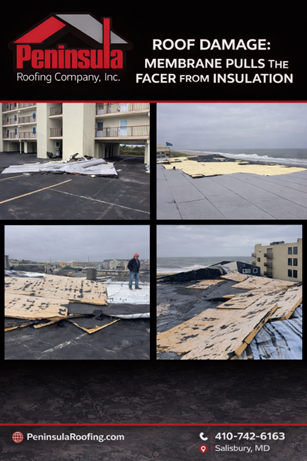
Billowing happens when the roofing membrane (the top waterproof layer) detaches from the insulation beneath it. This is a major red flag. Once that membrane is loose, the wind can get under it, creating a giant sail.
If the wind is strong enough, it doesn't just pull the membrane; it can pull the insulation boards too. When we peel back a failed roof and see the insulation boards scattered, overlapping, and turned at odd angles, we call that “jack-strawed” insulation.
Two different “why” scenarios: installation problem vs. engineered limits
A blow-off (or near blow-off) usually falls into one of two buckets:
Improper installation / compromised bond (avoidable): The system didn’t develop the bond or attachment it was supposed to.
Exceeding engineered thresholds (not necessarily avoidable): The roof was installed correctly, but the wind uplift forces exceeded what the system (and sometimes the building design) was engineered to handle.
Why does the bond fail?
Often, it comes down to the deck. On many commercial buildings in our area, we are dealing with concrete decks. If a concrete deck isn’t properly primed before the adhesive is applied—or if the primer isn’t allowed to flash/dry correctly—the bond may never become strong enough to resist high-wind lift.
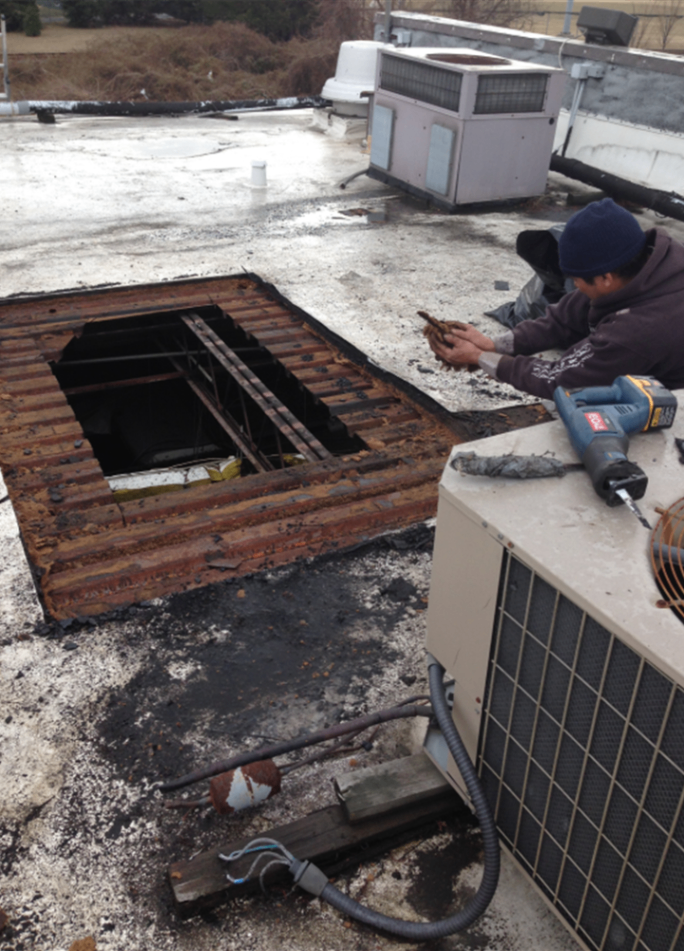
Another silent killer is moisture. Over years of service, tiny, unnoticed leaks can allow moisture to creep into the system. That moisture can weaken the chemical bonds between the adhesive, the membrane, and the insulation. When the big storm finally hits, the system is already compromised, leading to a failure that seems to come out of nowhere.
When Failure is Actually a "Success"
It sounds counterintuitive, but sometimes a roof failure is actually proof that the roof was installed correctly.
In a "fully adhered" system failure, we sometimes see the membrane pull completely off, but it takes the top layer (the facer) of the insulation with it. When you look at the roof, you see the foam of the insulation still firmly stuck to the decking, but the paper-like "facer" is gone, attached to the bottom of the blown-off membrane.
This is an engineered failure. It means the adhesive between the membrane and the insulation held perfectly. It means the insulation was fastened or glued to the deck perfectly. The roof only failed because the real-world wind speeds exceeded the material's physical "tear strength" or the engineered thresholds of the building. In other words, the storm was simply more powerful than what the materials were designed to handle.
As one of the leading roofing companies in Salisbury, MD, we analyze these failures to help our clients understand whether they’re looking at an installation/attachment issue, an aging/moisture-compromised system, or a roof that simply met forces beyond its engineered design.
The Warranty Reality Check
When you invest in a new roof, you’ll likely hear a lot about wind warranties. It’s important to read the fine print.
Standard manufacturer warranties for commercial roofs often top out at 50 to 55 mph. In a serious coastal storm, gusts can easily exceed these numbers. While you can certainly purchase "extended wind speed warranties" that cover up to 90 or 100 mph, you need to weigh the cost against the benefit.
The Hurricane Exclusion
Almost every major roofing manufacturer includes a "Hurricane Exclusion" in their warranty. This means that if a named storm or hurricane hits the Delmarva area, the warranty is often voided for wind damage: even if the recorded wind speeds at your specific building were below the "limit" on your warranty paper.
Because of this, paying a massive premium for a 120 mph warranty might not be the best use of your budget. Instead, we recommend focusing on Code Compliance. A roof in Salisbury, MD, that is installed properly to meet local building codes and manufacturer specifications is already designed to handle significant wind loads. Investing in high-quality installation and the right materials is often a better "insurance policy" than an expensive extended warranty with a dozen loopholes.
Prevention: How to Keep Your Roof on the Building
Preventing a blow-off starts long before the clouds turn gray. It starts during the planning and installation phase. Here are the keys to a wind-resistant roof:
Proper Priming: If you have a concrete deck, ensure your contractor is using the correct primer and allowing it to flash off properly.
Edge Securement: The edges and corners of a roof experience the highest wind pressures. Ensuring the metal coping and gravel stops are heavy-duty and installed to ES-1 standards (a specific wind-resistance test) is critical.
Moisture Management: Regular roof inspections can catch small leaks that would otherwise rot your insulation or weaken your adhesives.
Follow the Specs: Manufacturers have very specific "fastening patterns" for a reason. Whether it's the number of screws per board or the amount of glue per square, skipping steps to save time is a recipe for a blow-off.
Why Local Expertise Matters
When you search for "roofing companies in Salisbury, MD," you’ll find plenty of options. But when it comes to the technical physics of wind lift and commercial membrane integrity, experience is everything.
At Peninsula Roofing Company, Inc., we don't just "slap on a roof." We understand the local climate and the specific challenges of building near the coast. Whether we are working on a massive commercial warehouse or a residential home, we follow the manufacturer's and engineer's specs to the letter. We want to make sure that the next time the wind starts acting like an airplane wing, your roof stays exactly where it belongs: on your building.
If you’re concerned about the wind uplift rating of your current roof, or if you’ve noticed billowing or loose edges after a recent storm, don’t wait for the next hurricane to find out if your roof will hold. Contact us today for a professional assessment. We’ve been protecting Salisbury for over 75 years, and we’re ready to help you too.
Need a professional eye on your roof?Call Sean Fahey and the team at Peninsula Roofing Company, Inc. at 410-742-6163 or visit us at 1209 N. Salisbury Blvd., Salisbury, MD 21801.
(Visual: Peninsula Roofing Company Business Card or Logo)
Comments